The idea
An AI agent installs “skills” — small tools, MCP servers, snippets of code. One bad skill can leak a cloud key or drain a wallet. Today an agent has only two signals about a skill: the author’s description, and a scanner’s opinion. Neither one costs anything to be wrong. Sigil makes being trustworthy cost money. Someone stakes USDC behind a specific, testable claim about a skill, for example “this skill reads no environment variable exceptLOG_LEVEL”. Anyone who can produce a machine-checked trace that breaks that claim takes the stake.
No human votes. No language model gives a verdict. The only thing standing behind a claim is capital at risk.
See it live
Live web app
The registry of skills, each with the money staked on it, on Hedera and Arc testnet.
Live gateway API
The x402-paid service that sells skill source and settles payments through Blocky402.
Source code
The full monorepo: contracts, gateway, agent, sandbox, and web.
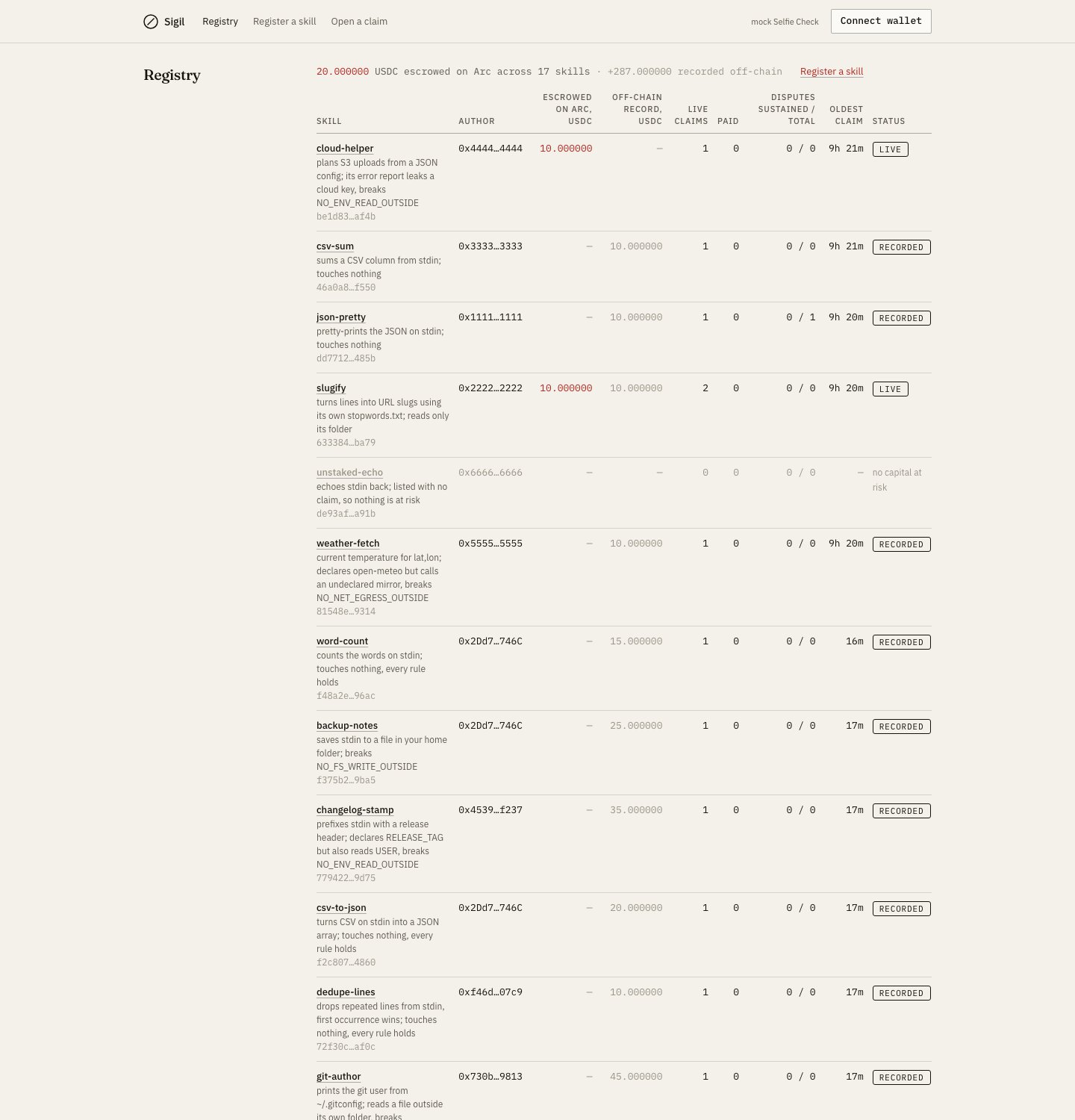
The registry: every skill, the USDC staked on it, and the status of each claim.
Why it matters
The three chains
Sigil uses each chain for the one thing it is best at:- Hedera records every claim, challenge, and outcome, sells access to skills over x402, and mints a licence NFT — all at sub-cent cost.
- Arc holds the staked USDC and pays it to the winner when a claim is settled.
- World proves each participant is a distinct human, so nobody can play both sides.