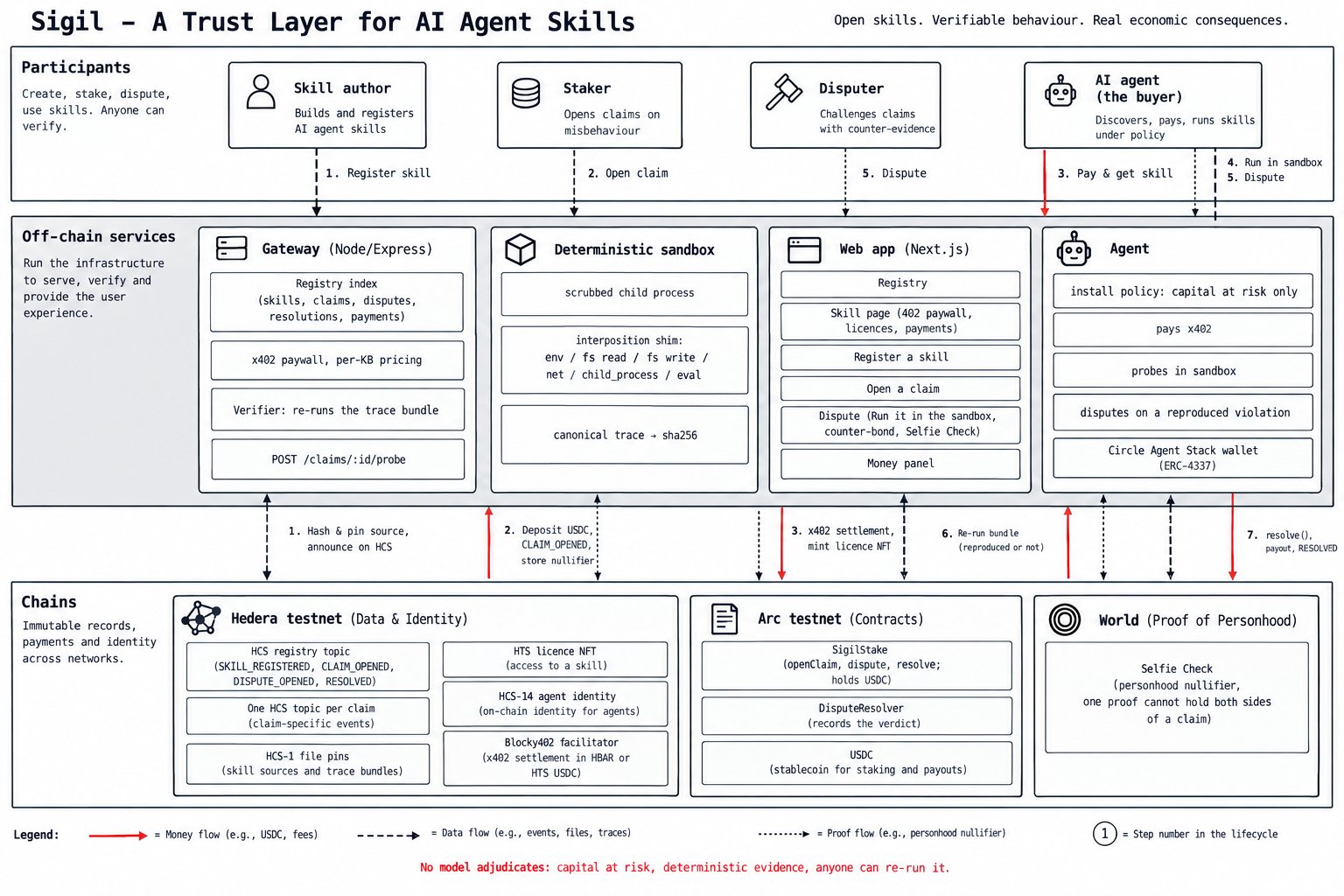
The system at a glance: web, gateway, agent and sandbox off-chain; Hedera, Arc and World underneath. The red arrow is the money path.
The parts
Why three chains
No single chain does all three jobs well.Personhood is load-bearing, not decoration
Here is the attack Sigil has to stop. One operator opens a claim from wallet A, then disputes it from wallet B with a trace they know will fail to reproduce. They lose the bond back to themselves, and now own a skill with a “survived a challenge” history. Total cost: gas. Sigil stores the World Selfie Check nullifier (a per-person, per-app identifier) on every claim and every dispute. A dispute whose nullifier matches the claim’s is refused with409 — one personhood proof cannot hold both sides of a claim. The contract also rejects a disputer who is the staker. The rule is tested, and enforced the same way in mock mode and in production.
Key addresses and IDs
Hedera registry topic
0.0.10483153 — every skill, claim, and identity is announced here.
Licence NFT (HTS)
0.0.10483154 — minted to each payer on settlement.
SigilStake (Arc)
0x66fc6324…1566fe — holds the staked USDC and pays the winner.
DisputeResolver (Arc)
0xb741a78b…56e1a8 — records the verifier’s verdict on-chain.
ARCHITECTURE.md in the repo.