> ## Documentation Index
> Fetch the complete documentation index at: https://sigil-docs-568611a1.mintlify.site/llms.txt
> Use this file to discover all available pages before exploring further.
# Architecture
> Five parts, three chains, and why each chain earns its place.
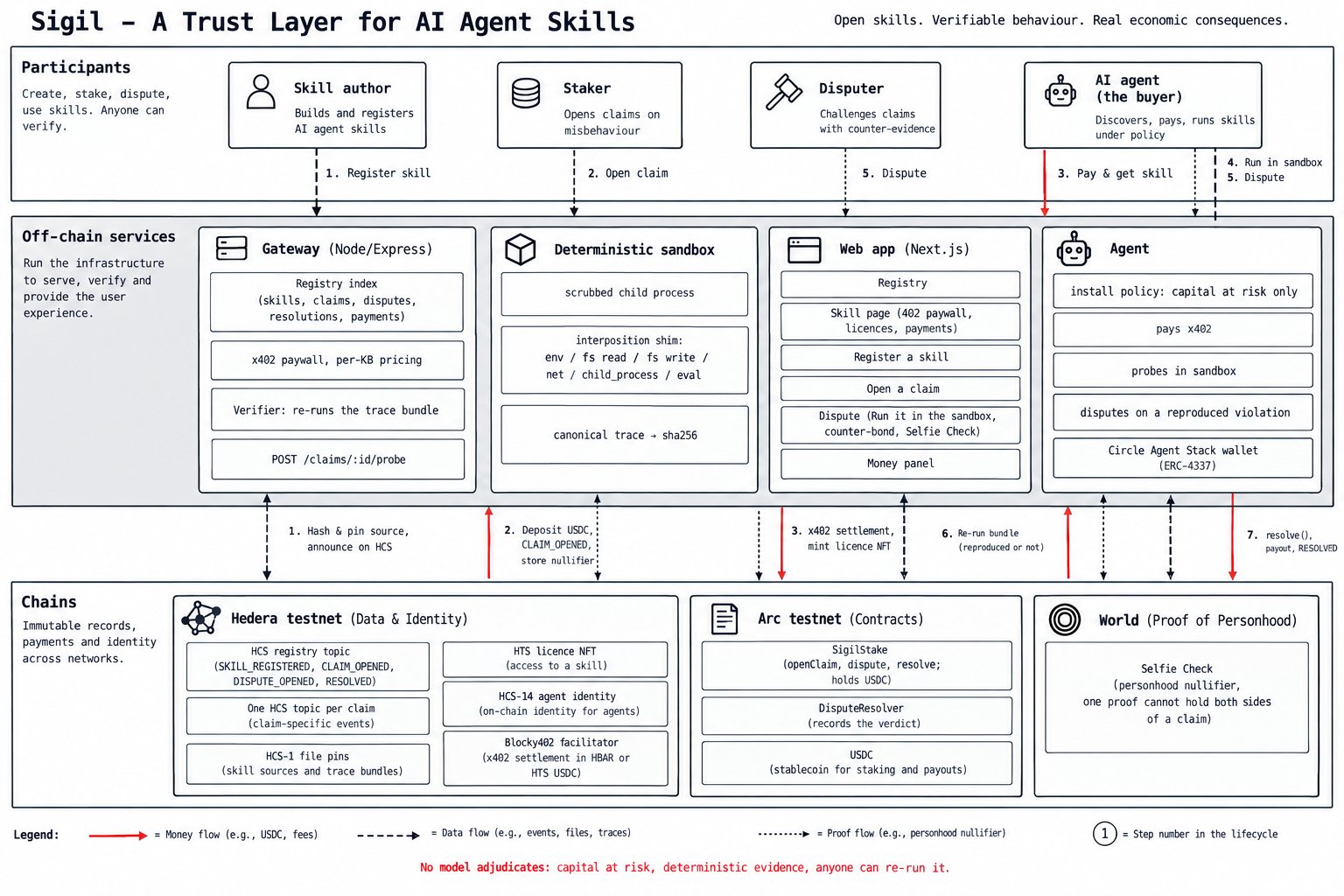
Sigil is a small monorepo. Each piece does one job, and each chain is used for the one thing it is best at.
 ## The parts
| Part | What it is | Where it lives |
| ------------------- | ------------------------------------------------------------------------------------------------------------ | ------------------------------------ |
| **Gateway** | The x402-paid service. Sells skill source, records claims and disputes, runs the verifier, writes to Hedera. | `packages/gateway` |
| **Agent** | The consumer. Discovers skills, pays over x402, probes them in the sandbox, and disputes what breaks. | `packages/agent` |
| **Sandbox** | The sealed, deterministic runner. Deny-by-default, produces the trace hash. | `packages/sandbox` |
| **Contracts** | `SigilStake` (escrow) and `DisputeResolver` on Arc. | `packages/contracts-arc` |
| **Web** | The public ledger UI: registry, register-a-skill form, skill pages, claim and dispute screens. | `packages/web` |
| **Shared / Hedera** | Common types and hashing; the Hedera client for topics, licence NFT, and identity. | `packages/shared`, `packages/hedera` |
## Why three chains
No single chain does all three jobs well.
| Job | Chain | Why it has to be there |
| ------------------------------------------ | ------------------------------- | -------------------------------------------------------------------------------------------------------------------------------- |
| Record every claim, challenge, and outcome | **Hedera Consensus Service** | Sub-cent fees and 3-second finality. On any chain with real gas, writing down every event would cost more than the stake itself. |
| Mint the licence NFT | **Hedera Token Service** | Native tokens with no contract to deploy or audit. |
| Sell paid access to a skill | **Hedera x402 (via Blocky402)** | The paid-request rail the Hedera track is built around. Per-call metering at sub-cent cost. |
| Hold the staked USDC and pay the winner | **Arc** | Stakes are real money. Arc is the USDC-native settlement layer, and its gas is paid in USDC too. |
| Prove each participant is a distinct human | **World Selfie Check** | Without it, one person funds both sides of a claim and manufactures a track record for free. |
## Personhood is load-bearing, not decoration
Here is the attack Sigil has to stop. One operator opens a claim from wallet A, then disputes it from wallet B with a trace they know will fail to reproduce. They lose the bond back to themselves, and now own a skill with a "survived a challenge" history. Total cost: gas.
Sigil stores the World Selfie Check **nullifier** (a per-person, per-app identifier) on every claim and every dispute. A dispute whose nullifier matches the claim's is refused with `409 — one personhood proof cannot hold both sides of a claim`. The contract also rejects a disputer who is the staker. The rule is tested, and enforced the same way in mock mode and in production.
## Key addresses and IDs
0.0.10483153 — every skill, claim, and identity is announced here.
0.0.10483154 — minted to each payer on settlement.
0x66fc6324…1566fe — holds the staked USDC and pays the winner.
0xb741a78b…56e1a8 — records the verifier's verdict on-chain.
The deep contract of every HTTP route, ABI, and HCS message is in [`ARCHITECTURE.md`](https://github.com/sm-xd/sigil/blob/main/ARCHITECTURE.md) in the repo.
## The parts
| Part | What it is | Where it lives |
| ------------------- | ------------------------------------------------------------------------------------------------------------ | ------------------------------------ |
| **Gateway** | The x402-paid service. Sells skill source, records claims and disputes, runs the verifier, writes to Hedera. | `packages/gateway` |
| **Agent** | The consumer. Discovers skills, pays over x402, probes them in the sandbox, and disputes what breaks. | `packages/agent` |
| **Sandbox** | The sealed, deterministic runner. Deny-by-default, produces the trace hash. | `packages/sandbox` |
| **Contracts** | `SigilStake` (escrow) and `DisputeResolver` on Arc. | `packages/contracts-arc` |
| **Web** | The public ledger UI: registry, register-a-skill form, skill pages, claim and dispute screens. | `packages/web` |
| **Shared / Hedera** | Common types and hashing; the Hedera client for topics, licence NFT, and identity. | `packages/shared`, `packages/hedera` |
## Why three chains
No single chain does all three jobs well.
| Job | Chain | Why it has to be there |
| ------------------------------------------ | ------------------------------- | -------------------------------------------------------------------------------------------------------------------------------- |
| Record every claim, challenge, and outcome | **Hedera Consensus Service** | Sub-cent fees and 3-second finality. On any chain with real gas, writing down every event would cost more than the stake itself. |
| Mint the licence NFT | **Hedera Token Service** | Native tokens with no contract to deploy or audit. |
| Sell paid access to a skill | **Hedera x402 (via Blocky402)** | The paid-request rail the Hedera track is built around. Per-call metering at sub-cent cost. |
| Hold the staked USDC and pay the winner | **Arc** | Stakes are real money. Arc is the USDC-native settlement layer, and its gas is paid in USDC too. |
| Prove each participant is a distinct human | **World Selfie Check** | Without it, one person funds both sides of a claim and manufactures a track record for free. |
## Personhood is load-bearing, not decoration
Here is the attack Sigil has to stop. One operator opens a claim from wallet A, then disputes it from wallet B with a trace they know will fail to reproduce. They lose the bond back to themselves, and now own a skill with a "survived a challenge" history. Total cost: gas.
Sigil stores the World Selfie Check **nullifier** (a per-person, per-app identifier) on every claim and every dispute. A dispute whose nullifier matches the claim's is refused with `409 — one personhood proof cannot hold both sides of a claim`. The contract also rejects a disputer who is the staker. The rule is tested, and enforced the same way in mock mode and in production.
## Key addresses and IDs
0.0.10483153 — every skill, claim, and identity is announced here.
0.0.10483154 — minted to each payer on settlement.
0x66fc6324…1566fe — holds the staked USDC and pays the winner.
0xb741a78b…56e1a8 — records the verifier's verdict on-chain.
The deep contract of every HTTP route, ABI, and HCS message is in [`ARCHITECTURE.md`](https://github.com/sm-xd/sigil/blob/main/ARCHITECTURE.md) in the repo.